

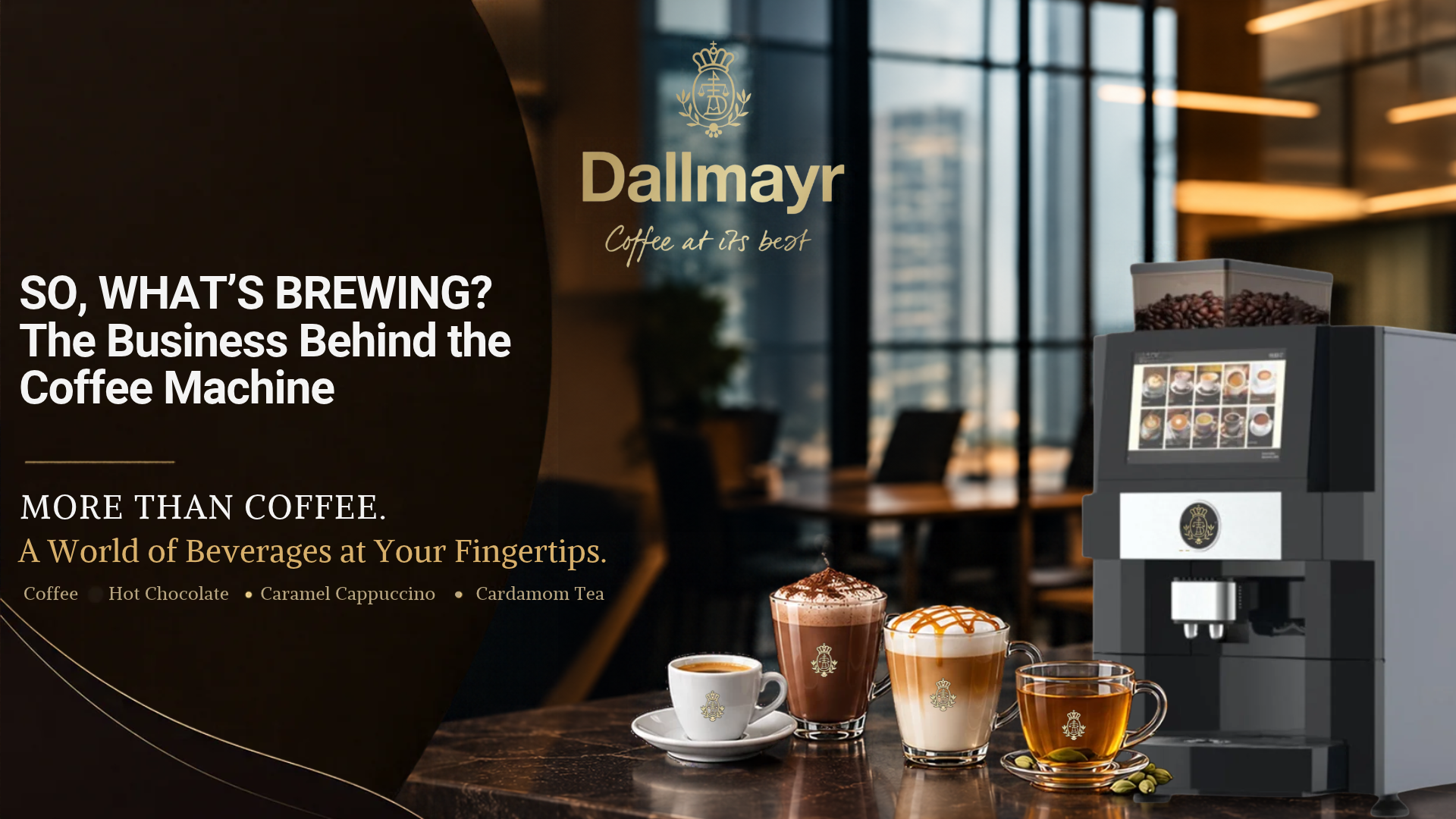
SO, WHAT’S BREWING?
The Business Behind the Coffee Machine
Bean There, Done Business | Dallmayr South Africa
When a business considers installing a coffee machine, the first questions are often straightforward: How much will it cost? Where will it be placed? How many people will use it?
But behind every workplace coffee machine is a bigger business decision, one that involves convenience, operational efficiency, service delivery and the everyday experience of employees.
A coffee machine may occupy only a small space in an office, but the solution behind it requires considerably more thought.
Beyond the machine: understanding the business need
Every workplace operates differently. A corporate office with hundreds of employees has different requirements from a small professional practice, a hospital, a university campus or a manufacturing facility.
Before selecting a coffee solution, businesses need to consider their working environment, employee numbers, daily foot traffic, available space and expected consumption.
A solution that works well in one environment may not necessarily be suitable for another.
For example, a busy workplace may require a machine that can serve multiple users throughout the day, while a smaller office may prioritise simplicity, convenience and efficient use of space.
The objective is not simply to install a machine. It is to identify a solution that fits the needs of the people who will use it.
The operational side of workplace coffee
The customer sees the finished cup of coffee. Behind that experience, however, is an operational process that must function consistently.
Coffee supplies need to be replenished. Machines require cleaning and maintenance. Technical issues must be addressed, and someone needs to take responsibility for ensuring that the service remains available.
Without proper planning, even a quality coffee machine can become an inconvenience rather than a benefit.
This is why businesses should look beyond the equipment itself and consider the complete service offering. Depending on the arrangement, this may include installation, product supply, routine servicing, technical support and replenishment.
When these responsibilities are clearly defined, businesses can make more informed decisions about the practical requirements of introducing workplace coffee.
What does the coffee machine mean for employees?
Workplace coffee is also part of the everyday employee experience.
For many people, coffee is incorporated into their working routine. It may accompany a morning meeting, provide a reason for colleagues to connect or offer a convenient refreshment during a busy day.
However, employee convenience depends on more than the availability of coffee. Accessibility, consistency, product choice and the reliability of the machine all influence the experience.
Businesses should therefore consider the needs of the people using the solution, rather than making decisions based solely on the equipment or its initial cost.
The question becomes: How can workplace coffee be made accessible and convenient without creating unnecessary operational demands?
The commercial question: cost, value and responsibility
Every business investment requires careful consideration of cost and value.
When evaluating a workplace coffee solution, decision-makers should look at the complete arrangement. This includes equipment costs or rental terms, coffee and other consumables, maintenance, servicing, payment options where applicable, and the responsibilities assigned to the supplier and the business.
Different solutions operate under different commercial models. Some may involve equipment rental, while others may be structured around agreed consumption volumes or alternative arrangements.
Understanding these terms from the beginning helps businesses assess whether a solution is commercially appropriate for their environment.
It is equally important to establish who manages replenishment, how faults are reported, what support is available and what happens when operational requirements change.
The cheapest machine is not automatically the most suitable option. The right decision depends on the business’s needs, the service provided and the overall value of the arrangement.
Choosing a coffee partner, not just a machine
A workplace coffee solution is a continuing service relationship.
Businesses should consider whether a provider understands their environment, can explain the available options and has a clear approach to maintenance, supply and support.
Communication matters. So does accountability.
The right provider should be able to discuss the practical requirements of the installation, help identify a suitable solution and clarify the responsibilities of each party before implementation begins.
For office managers, HR teams, facilities managers and business owners, these are important considerations when determining whether workplace coffee can be managed effectively over the long term.
So, what’s brewing in your workplace?
The business behind a coffee machine is about much more than the machine itself. It involves understanding people, planning operations and selecting a solution that makes sense commercially.
At Dallmayr South Africa, we believe workplace coffee should bring together quality, convenience and reliable service. Every workplace has different requirements, which is why understanding the environment is an important starting point.
Because the best workplace coffee solution is not simply the one that serves a good cup. It is the one that works for the business and the people who depend on it.
How does your workplace currently manage its coffee needs and what would you improve about the solution you have in place?
Share your perspective in the comments.
Dallmayr South Africa | Coffee at its best.
Bean There, Done Business — where coffee meets business.